"Old Bricks - history at your feet"
England - page 19h, Letter R
Rowley to Rushden
Rowley & Co
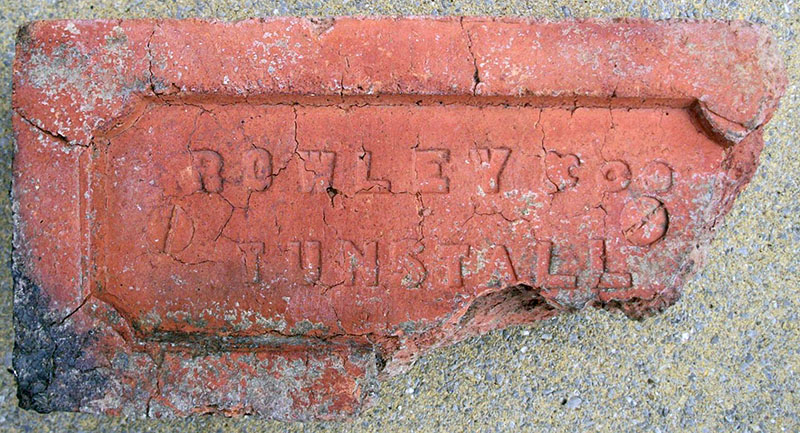
Rowley & Co, Tunstall, are listed in a trade directory for 1872. The likely location is the Hollywall Tileries which were to let in 1869 and in the marl pit of which this brick was found and photographed by Ken Perkins.
Rowley Station
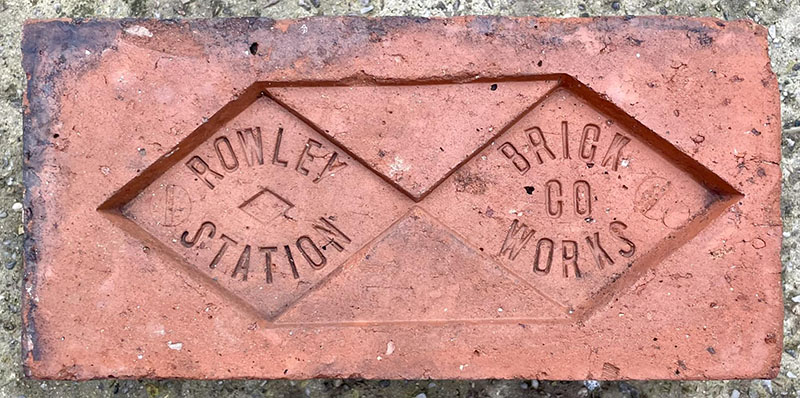
This is a paver. Photo by Phil Burgoyne. Martyn Fretwell writes: Rowley
Station Brick Works Co. (David Cook Manager) Cakemore,
Blackheath, Dudley is recorded in Kelly's 1900 edition.
Royal Oak, Whiston
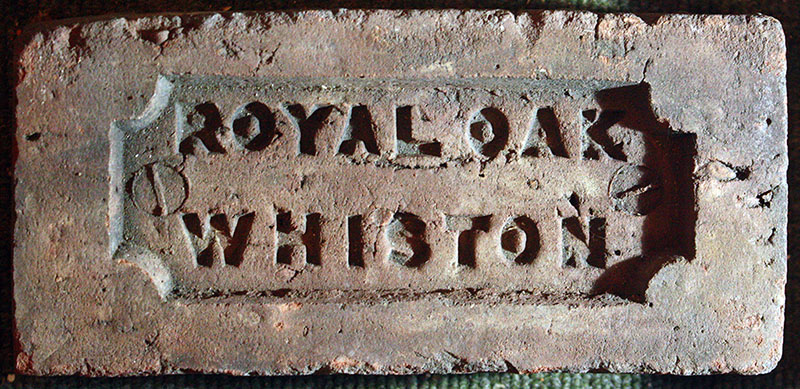
Whiston is between St Helens and Liverpool.
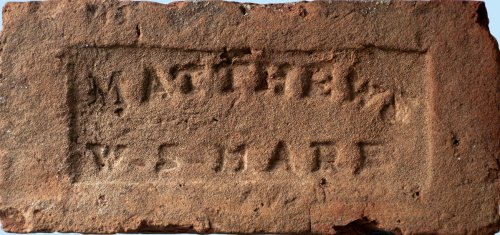
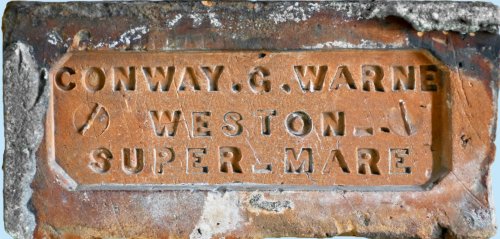
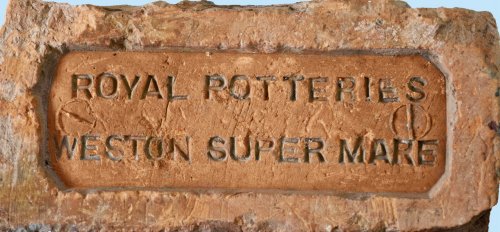
Royal Potteries, Weston Super Mare
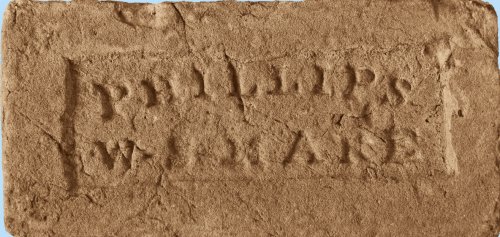
Charles Phillips born 1816 in Badgworth, Somerset was already
skilled at the potters wheel by the age of nine. John
Mathews was a native of Scotswood in Northumberland. Mathews
acquired the sole patent to Pooles patent bonding Roll Tile.
Conway Gould Warne was formerly a potter in Rochester in Kent,
Warne invented two new products, a land drain well and an electric
cable trough. The Royal Potteries started probably around
1837. In 1847 the clay in Weston was pronounced by
competent judges to be of better quality than any other in the
country. By the late 1930s a thousand workers were employed
there. In 1952 the Pottery received its last Royal order for
126,000 flower pots to be used in the Coronation displays around
London. Weston pottery was then still considered to be the
best in the country. The Pottery went into voluntary
liquidation in November 1961. Thanks to John Biggs for the
photos and information.
Royshaw, Blackburn
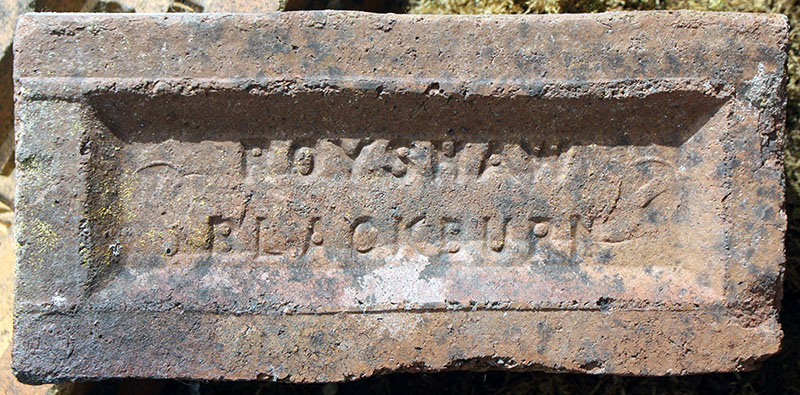
Royshaw Brickworks Co., Royshaw Brickworks, Blackburn. The brickworks was established in 1887 by William Matthews. It was rebuilt in 1932 by the Royshaw Brickworks Co.and was later taken over by John Woods Brick & Tile Co. Ltd. of Bog Height Darwen. It closed in the early 1950's. Info by Colin Driver.
Rudd & Son, Grantham
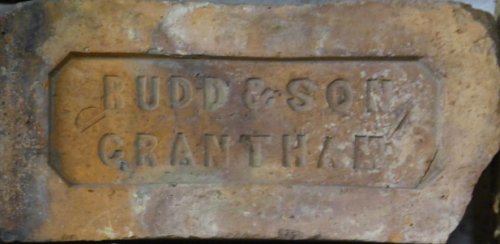
Kellys 1876 edition lists Rudd & Son at Brick Kiln Lane,
Spittlegate, Grantham. Kellys 1885 to 1905 editions then records him
at Wharf Road, Grantham, but this will have been his office address.
Entries in Kellys 1909 to 1930 then gives the works address as
Springfield Road. Old maps have revealed that Brick Kiln Lane was
renamed Springfield Road. Info & Photo by Martyn Fretwell.
Rudgwick
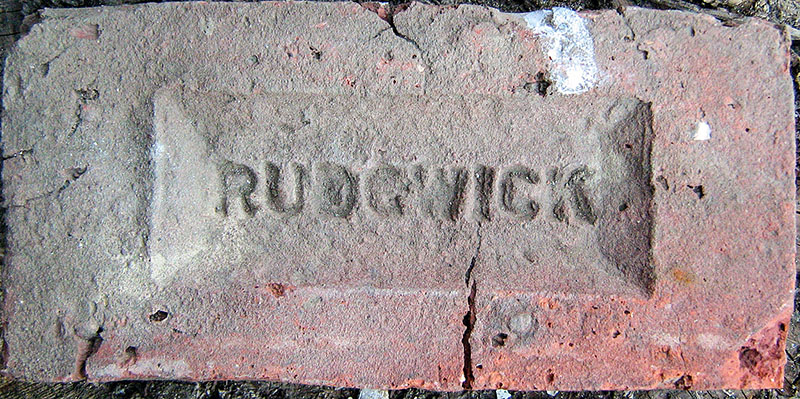
Harold Tate, a builder and master brickmaker, started the brickworks at Rudgwick in Sussex c1928. After closure for the duration of the war and the death of Harold Tate in 1940, the Fawke family brought the works back into production in 1947. New machinery boosted production to 45,000 bricks a week and then in 1963-5, the works was modernised with an automatic brick making machine capable of producing 250,000 bricks a week. Baggeridge Brick PLC, based in bought out Rudgwick Brickworks Co Ltd in 1998, and in 2006 they in turn were taken over by Wienerberger who operated the works until closure in c2010. There were no kilns and the 1m brick clamps were still built by hand right to the end. Photo by Richard Symonds.
More information about the works can be found here.
Rufford, Stourbridge
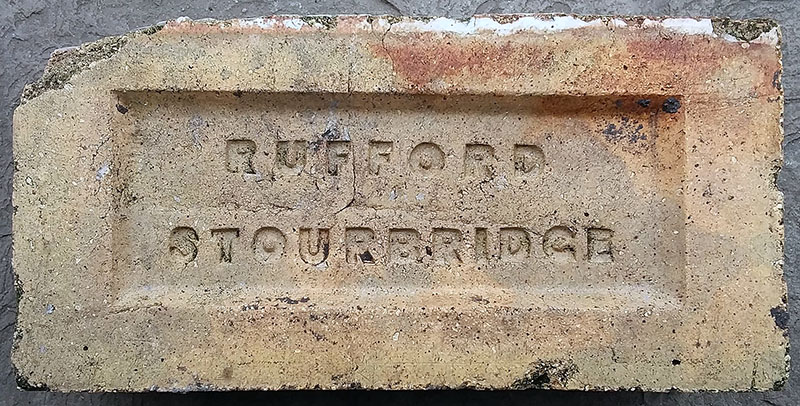
Photo by David Fox.
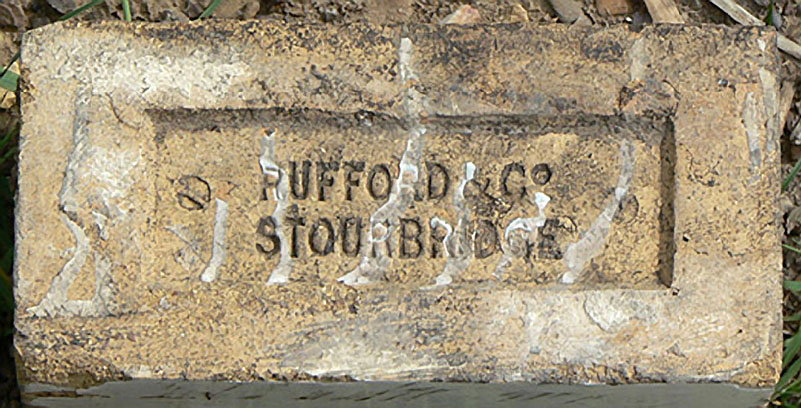
Photo by Alan Murray-Rust
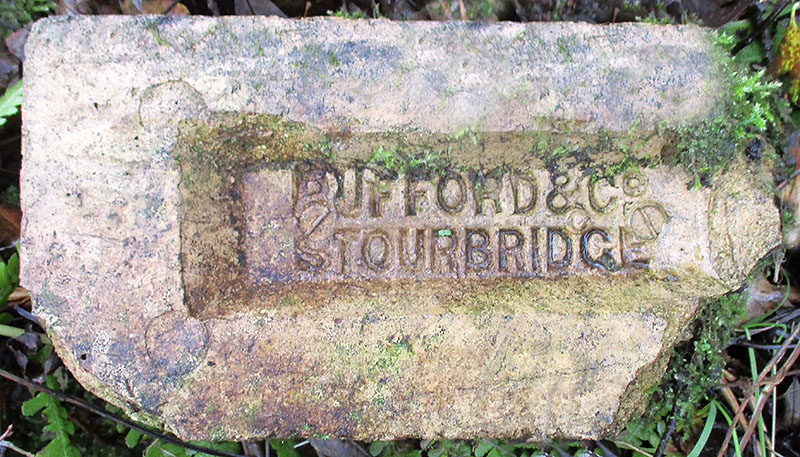
Photo by Mike Shaw.
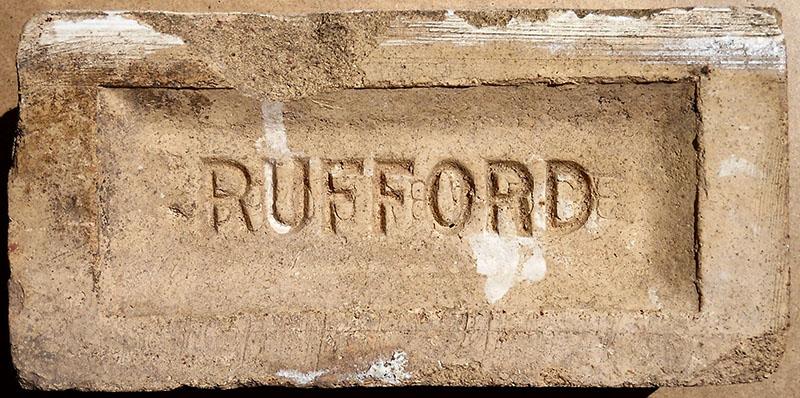
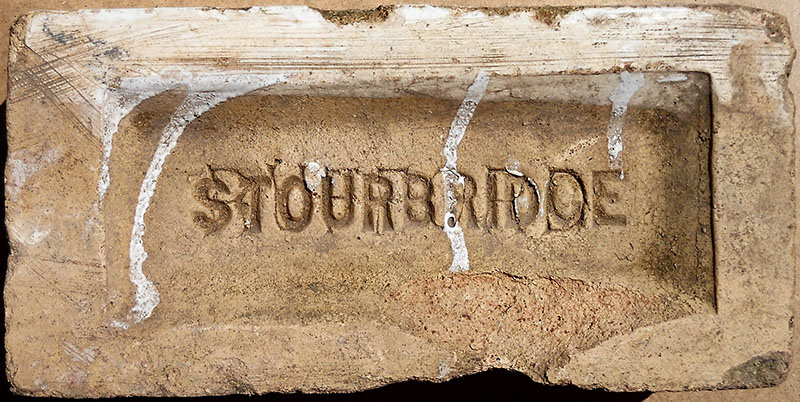
Front and back of a Rufford brick. Both sides have the faint imprint of the wording on the opposite side too. Photos by Ray Martin.
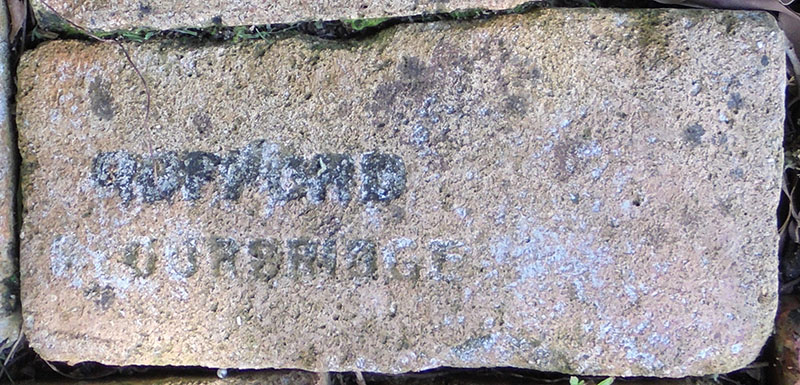
An ancient Rufford example spotted at Sunbury Plantation House,
Barbados by Paul Hughes. It probably arrived there as ships
ballast.
Made in Stourbridge by Rufford & Co. A history of the business can be found here.
Rufus
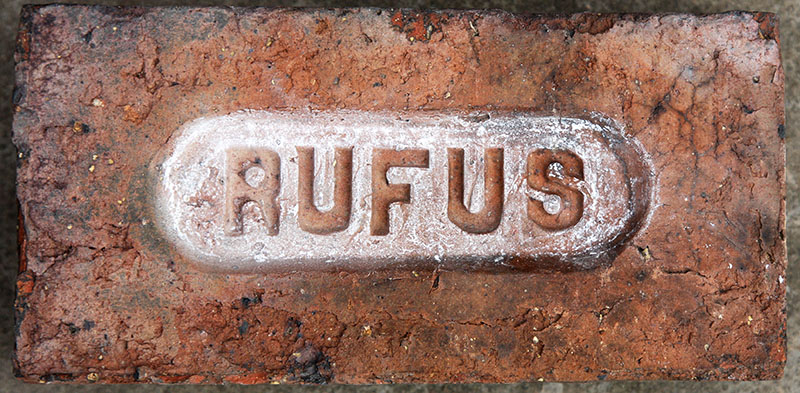
Rufus (Proctor Bros.) Brick & Tile Ltd, Newcastle-under-Lyme, Staffordshire. The brick yard opened by 1932 and was situated in the Bradwell Wood area near Parkhouse colliery (coal & clay). The yard also made roof and floor tiles and eventually closed in 1960. The clay (marl) in this area was dug out from the hillside of the woodland as opposed to the conventional method of extracting from marl holes. Thanks to Ken Perkins for the
photo and history.
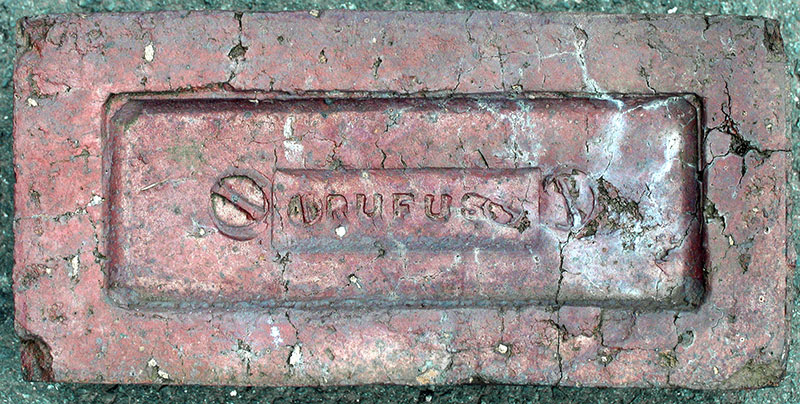
Photo by David Kitching.
Rugby Brick Co
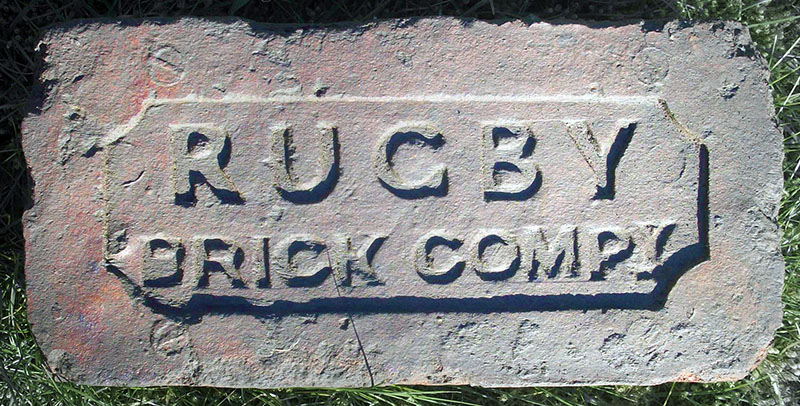
The Rugby Brick Co., Ltd. is listed as a manufacturer of Common Bricks in the 1901 Directory of Clayworkers. The office address is given as 84, James Street, Rugby. It is also listed in the 1900 Kelly's Directory but not before or in 1904, so appears to have been a short-lived affair. The 1904 OS map shows a disused brickworks to the south-east of the town in the Bilton area. Photo by David Tilsley.
Rushbrooke
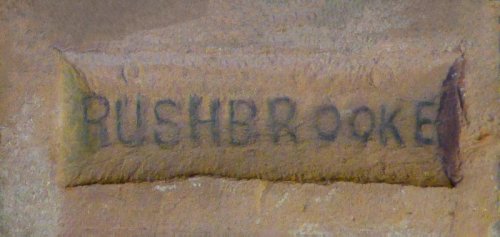
Kellys 1888 edition lists William Rushbrooke
at Westley, Bury St. Edmunds, but this may have been his home
address. Kellys 1892 edition then lists William with the address of
Rushbrooke, Bury St. Edmunds. Delving into the web has revealed that
Rushbrooke village & Rushbrooke Hall where named after the
Rushbrooke family, but alas William Rushbrooke's family were no
longer the owners of the Hall or village in 1892. We then find that
William Rushbrooke is listed in Kellys 1896 & 1900 editions as
brickmaking at Little Whelnetham, Bury St. Edmunds. The 1882 &
1903 OS maps do show a brickworks in Little Whelnetham (det.). This
village is marked on maps in two places with the main part of the
village being on the southern edge of the Rushbrooke Hall Estate,
however the brickworks was situated in the Little Whelnetham marked
as det. (= detached) & near to the entrance driveway to
Rushbrooke Hall, just north of Sicklesmere. I am thinking that
William Rushbrooke was at this Little Whelnetham brickworks from
1888 to 1900. Just to note that the site of this former brickworks
is today farming land on the edge of Sicklesmere & is no longer
marked as Little Whelnetham. Info & Photo by Martyn Fretwell.
Rushden Brick & Tile
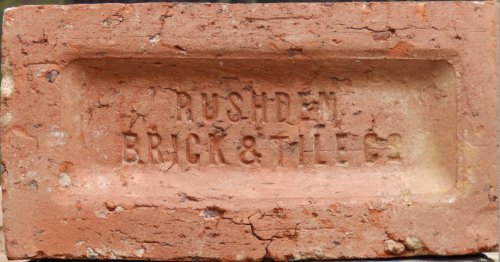
In the 1851 census a Jeremiah Litchfield and a Thomas Hardwick were
recorded as brick makers in the Rushden area.
1864 - 1884 a Robert Octavius Butcher was operating a small brick
yard with a single kiln, he was recorded in the trade directories as
a grocer and brick maker.
By 1894 the large works of Rushden Brick & Tile Co., founded by
John Clark, was in operation using a continuous kiln. The whole site
of 116 acres was served by a tramway system, and there was a sand
pit to the east of the works. During the 1880's and 1890's they were
working at full capacity to keep the builders supplied as several
new streets were being built. On 15th June 1900 the works was struck
by lightening causing '300 of damage and throwing a number of men
out of work for some weeks. A 1933 letterhead shows that they were a
limited company making hollow partition and flooring bricks,
agricultural drainpipes, red pressed and wirecut bricks, and
supplying silica sand and ganister for cupola lining and general
refractory purposes. By 1st May 1941 the whole works, plant and
machinery, steam engines, boiler, rails, etc. was up for sale.
Photo and info by Nigel Furniss.
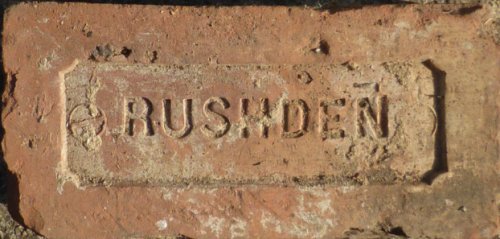
Photo by Martyn Fretwell courtesy of the Bill Richardson Collection
at Southwick Hall.